
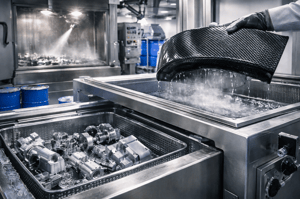
Industrial cleaning plays a critical role in manufacturing workflows where surface cleanliness directly affects performance, quality and downstream processing. In composite manufacturing and precision parts washing, cleaning solvents are relied on to remove resins, oils and contaminants without damaging components, molds parts produced or slowing production.
As solvent chemistry, availability and cost continue to change, manufacturers are re-evaluating how cleaning workflows operate. This is particularly true for applications that rely on vapor degreasing and vacuum vapor degreasing where engineered, low-boiling-point solvents can be and frequently are used an applied.
How Solvents Are Used in Composite and Parts Cleaning
In composite and precision parts applications, cleaning typically occurs before assembly, coating or bonding. Solvents such as acetone or engineered fluorinated solvents dissolve resins, oils and particulate residue that can compromise adhesion or tolerances.
In many high-value applications, cleaning is performed using vapor degreasing or vacuum vapor degreasing. Rather than relying on liquid immersion alone, these processes convert the solvent into vapor, which condenses on the part surface. Vapor provides greater surface coverage than liquid, allowing it to penetrate tight geometries and clean more effectively.
This is especially important for complex parts used in aerospace, medical devices and precision manufacturing, where incomplete cleaning can lead to costly failures.
Why Low-Boiling-Point Solvents Matter
Engineered solvents such as Novec™ and Vertrel™ (as well as many substitute fluorinated solvents such as Tergo™, Aerotron™ and others) are commonly used in vapor degreasing because they vaporize at relatively low temperatures, while providing high solvent power and low surface tension. This enables effective cleaning with minimal heat input, reducing energy demand and protecting heat-sensitive components.
During operation, solvent vapor rises within the degreaser chamber, contacts the part surface, condenses and dissolves contaminants. As the solvent becomes saturated, it collects in a sump where it can be removed for disposal or recycling. Over time (more pronounced in today's rising solvent cost environment), solvent saturation and subsequent disposal and loss drive up recurring material costs, thereby impacting production margins, especially in facilities with continuous cleaning operations.
Solvent Saturation, Loss and Recovery Challenges
As solvents are used repeatedly, contamination risks can increase and solvent quality power will decline. In many facilities, spent solvent is removed and replaced, contributing to high purchasing costs and increasing hazardous waste disposal volumes.
These challenges are becoming more pronounced as manufacturers face tightening regulations, supply constraints and rising costs associated with engineered solvents. Consequently, economics, phase-outs and restrictions affecting certain fluorinated solvent products have accelerated the need for better solvent management strategies across industrial cleaning operations.
Where Solvent Recovery Fits into Industrial Cleaning Workflows
Rather than treating solvent disposal as a fixed cost of doing business, many manufacturers are integrating on-site solvent recovery into their cleaning processes. Recovering solvents allows facilities to maintain consistent solvent performance, while reducing replacement frequency and limiting waste generation.
As manufacturers reassess how they manage low-boiling-point engineered solvents, some are implementing recovery systems designed specifically for these applications. Equipment systems such as SolvTrue™ S700C are engineered to support the recovery and reuse of solvents like Novec™ and Vertrel™ using controlled simple distillation with vacuum assist coupled with proprietary programming and design, allowing for efficient separation of solvent from contaminant at reduced operating temperatures while maintaining consistent solvent recovery performance.
The system was developed in response to increasing cost, availability and regulatory pressures affecting fluorinated solvents used in precision cleaning and related applications.
By enabling solvent reuse onsite, recovery systems help stabilize cleaning workflows without requiring changes to existing degreasing equipment or cleaning protocols.
How Solvent Changes Are Affecting Manufacturing and Laboratories
These changes are not limited to industrial cleaning. Similar transitions are occurring in laboratory environments, where xylene substitutes are increasingly used to reduce exposure risks while maintaining workflow compatibility. Across both industrial and laboratory settings, the underlying challenge is the same: maintaining performance while reducing risk, waste and long-term cost.
Managing Engineered Solvent Lifecycles
Cost pressure is becoming a defining factor across many engineered solvent applications as availability tightens and replacement options continue to evolve. Disposal costs and associated regulatory restrictions have become an increasing challenge for parts cleaning operations using these materials as well. In response, manufacturers are placing greater emphasis on solvent lifecycle management — including recovery, reuse and process optimization — rather than focusing solely on solvent selection.
How Your Company Can Benefit from On-Site Solvent Distillation
Learn how manufacturers are reducing waste, extending solvent life, and improving operational efficiency through on-site solvent recovery. Download our Guide: How Your Company Can Benefit from Onsite Solvent Distillation.
Key Considerations for Composite and Parts-Washing Operations
When evaluating solvent use in composite and part-washing workflows, manufacturers should consider:
-
Cleaning effectiveness across complex geometries
-
Compatibility with existing vapor degreasing equipment
-
Solvent saturation rates and replacement frequency
-
Waste generation and disposal costs
-
Opportunities for on-site solvent recovery
Addressing these factors together allows facilities to assess sustainable operations practices, reduce operating risk, while maintaining consistent cleaning performance.
Industrial Cleaning Efficiency Through Solvent Recovery
Industrial cleaning workflows are evolving as manufacturers adapt to changes in solvent chemistry, availability and cost. In composite and parts-washing applications, effective cleaning depends on consistent solvent performance — for example in vapor degreasing processes that rely on low-boiling-point engineered solvents or with acetone frequently used in mold cleaning in composite or fiberglass applications.
By integrating solvent recovery into these workflows, manufacturers can reduce waste, control costs and improve long-term operational resilience without disrupting established cleaning processes.
FAQs: Industrial Cleaning, Vapor Degreasing and Solvent Recovery
What is vapor degreasing, and why is it used in industrial cleaning?
Vapor degreasing is a cleaning process that uses solvent vapor to remove oils, resins and contaminants from parts. The vapor condenses on the surface, providing uniform coverage and effective cleaning of complex geometries that liquid cleaning alone may not reach.
Why are low-boiling-point solvents used in parts washing and composite cleaning?
Low-boiling-point solvents vaporize at lower temperatures, allowing efficient cleaning with reduced heat input, while providing high solvency and low surface tension. This helps protect heat-sensitive components while supporting consistent cleaning performance in precision applications.
What challenges are manufacturers facing with engineered solvents?
Manufacturers are seeing increased costs, tighter regulations and reduced availability for certain engineered solvents. These pressures are driving the need for better solvent lifecycle management, including recovery and reuse.
Can engineered solvents such as Novec™ and Vertrel™ be recycled?
Yes. When collected and processed correctly, engineered low-boiling-point solvents can be recovered using systems designed for controlled distillation with vacuum assist, allowing reuse, while maintaining consistent solvent performance.
How does solvent recovery fit into vapor degreasing workflows?
Solvent recovery allows spent solvent from vapor degreasing systems to be reclaimed and reused onsite. This reduces solvent replacement frequency, lowers hazardous waste volumes and helps stabilize operating costs.
Does solvent recovery affect cleaning performance?
No. When properly implemented, solvent recovery helps maintain consistent solvent concentration and cleaning effectiveness while reducing waste and material costs.
Which industries benefit most from solvent recovery in cleaning processes?
Industries that rely on precision cleaning — including aerospace, medical device manufacturing, electronics, composites and precision manufacturing — often benefit most due to high solvent usage and strict performance requirements.
COMMENTS